Contents:
History Of The L’Orient Express
How Much Does It Cost To Go On The L’Orient Express
Once known as the 'Nostalgie-Istanbul-Orient-Express' the iconic train journey sees its spirit extended in 'L'Orient Express' – the train that rode the tracks from Paris to Istanbul during the Golden Age of Travel is recaptured in the L'Orient Express, arriving 2027.
L’Orient Express seeks not to recreate the Nostalgie-Istanbul-Orient-Express but to imbue this new journey with the spirit and essence of the original, extending its glory and glamour.
L’Orient Express is carefully handcrafted, skilled artisans use revived and traditional techniques to elevate the on-board experience with lavish and rich aesthetics. Details are at the centre of this journey, composing light and form in a symphonic and elegant display with every step across the length of L’Orient Express.
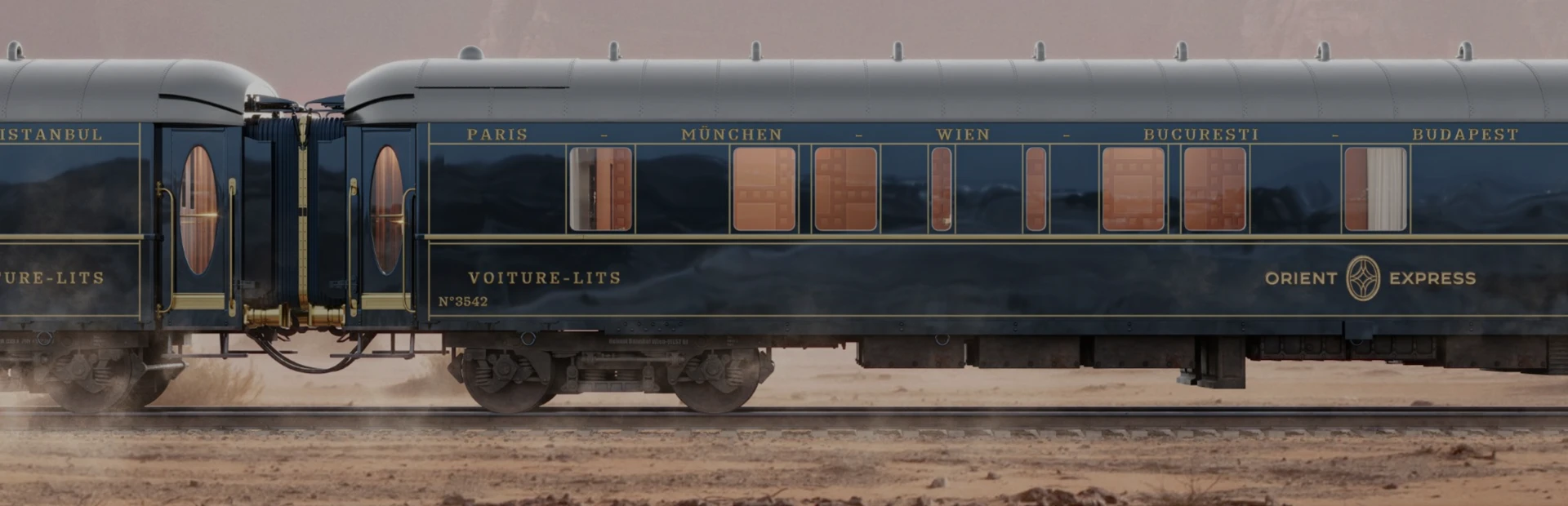
Several carriages of this heritage-rich train were thought to be lost to time after its last journey in 2009. This is a story of triumph, revival, and the longstanding French pride in its long history and culture.
History of the L’Orient Express
Over the years the 'Orient-Express' journey has seen numerous variations across its time on the tracks from 1883 to 2009.
This historic journey was founded by Georges Nagelmackers when he envisaged a "a train that would span a continent, running on a continuous ribbon of metal for more than 1,500 miles". Nagelmacker was inspired by the innovation of rail-travel in America including the British Pullman’s luxurious wagons-lits (sleeper trains) and upon his return, he was ready to realise his picture of a train which would span the continent. In 1883, Compagnie Internationale des Wagons-Lits was established.
The journey coincided with the ’Beautiful Era’ known as ‘La Belle Époque’ circa 1871, which, like L’Orient Express, is characterised by prosperity, the Art Nouveau movement, and a certain joie de vivre which marked the end of the Franco-Prussian War.
The original journey mainly welcomed members of the wealthy bourgeoisie, aristocrats, diplomats, and successful artists of the time. All drawn in by the train’s sense of grandeur and attractive amenities, including Lalique chandeliers, entertainment, and a high-class culinary experience.
Regarding the dining car, Henri Blowitz, a journalist, had written, “The bright-white tablecloths and napkins, artistically and coquettishly folded by the sommeliers, the glittering glasses, the ruby red and topaz white wine, the crystal-clear water decanters and the silver capsules of the champagne bottles—they blind the eyes of the public both inside and outside”.
The menu of the original journey took on classic French cuisine and culinary techniques, featuring dishes like poularde mascotte, jambon et rosbif à la gelée, and crème Lutetia with ingredients sourced meticulously from stops across Europe, ensuring the finest and freshest quality. The menu was tailored for the journey, focusing on seasonal produce, local and native to the areas where the train made its passage.
Post World War I, the route of the Nostalgie-Istanbul-Orient-Express saw some changes – the suspicion towards Germany meant that a more southern route was established – the Simplon-Orient Express, taking passage through the Simplon Tunnel, Milan and Venice rather than Munich and Vienna as it did in its original route. This iteration of the journey was highly attractive and popular and is what inspired many artists’ work, including Agatha Christie's 1934 novel, Murder on the Orient Express, and Ian Fleming's 5th James Bond novel, From Russia with Love, in 1957.
Eventually, in 1977, the Orient Express stopped service to Istanbul, and in 2009, provided their last journey aboard from Stamburg to Vienna.
Since then, the locations of the original carriages had been lost to time until circa 2015, when French researcher, Arthur Mettetal rediscovered 13 carriages, abandoned at Małaszewicze station on the Poland-Belarus border. Later, another 4 carriages were found in nearby countries, including Switzerland and Germany, which now brings us the L’Orient Express, rebuilt and reimagined from the storied history of the original Nostalgie-Istanbul-Orient-Express carriages in 2027.
17 Carriages
Aboard the L’Orient Express, there are 17 exceptionally curated carriages, capturing the essence of the original Nostalgie-Istanbul-Orient-Express. With all 600m2 Designed by architect Maxime d’Angeac and the various artists on this project, the L’Orient Express features all the glamour and classic 1920s design and décor with contemporary luxury codes and convenience.
L’Orient Express Suites
Aboard the L’Orient Express, the suites embody the spirit of the Nostalgie-Istanbul-Orient-Express with the refined French craftsmanship and stylish comfort for both days and evenings on this historic journey.
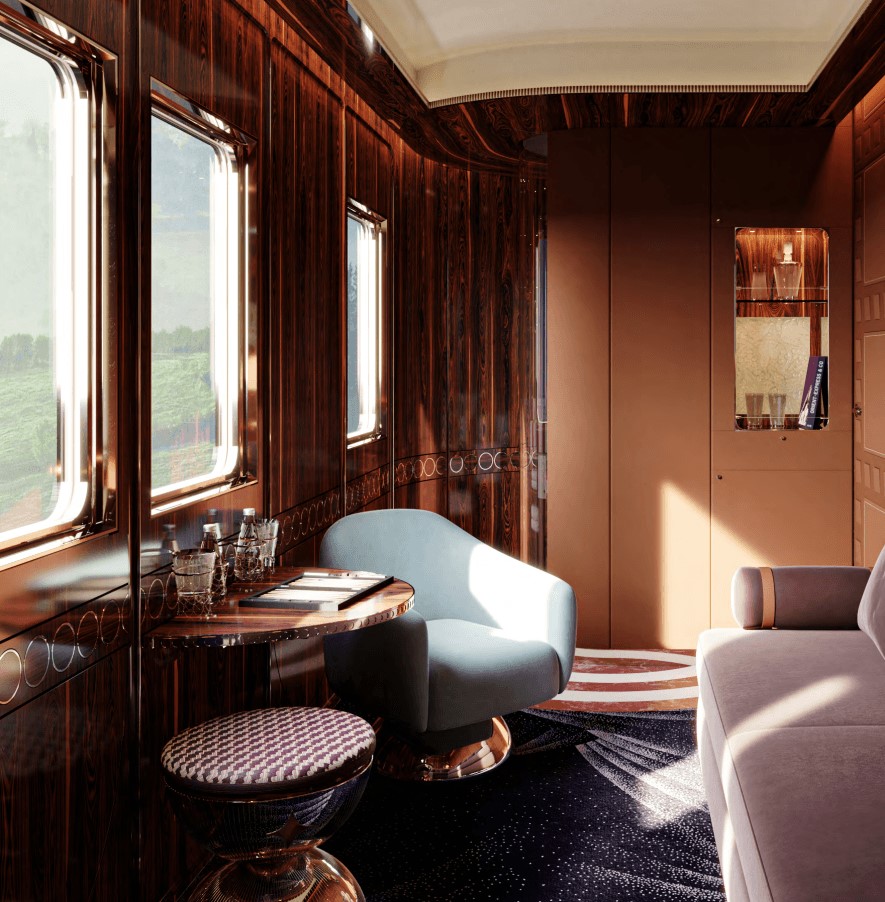
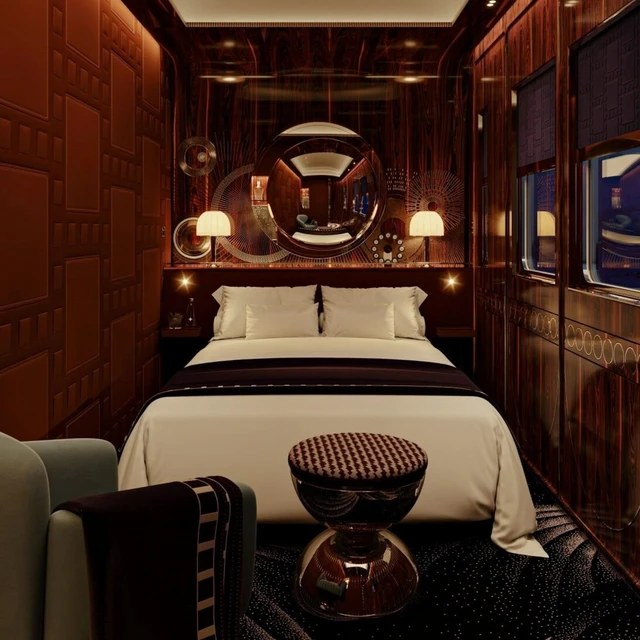
Composed circular motifs, a symbol of harmony and balance, as feng shui principles dictate, the circle represents and conveys a continuous and smooth flow of energy, evoking a sense of completeness and calm when passengers retreat to the suites.
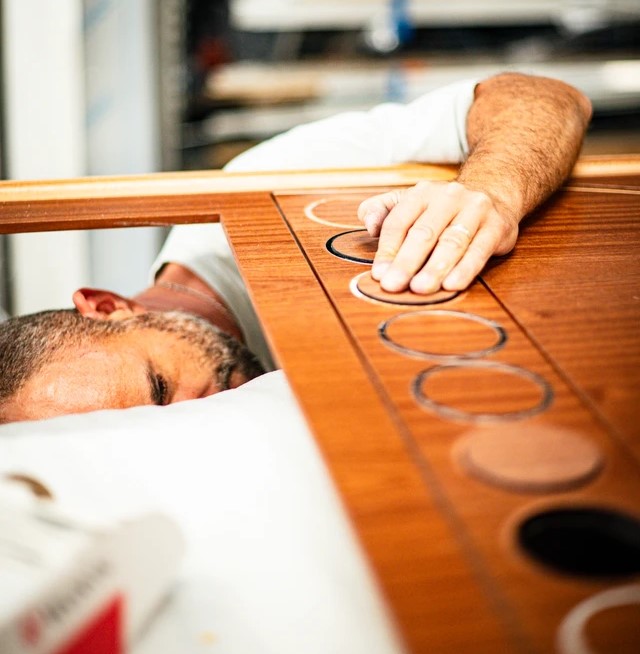
Restored from the original Nostalgie-Istanbul-Orient-Express cars, the ‘Blackbirds & grapes’ panelling decorates the suites alongside a bold reinterpretation of Suzanne Lalique’s rail motif.

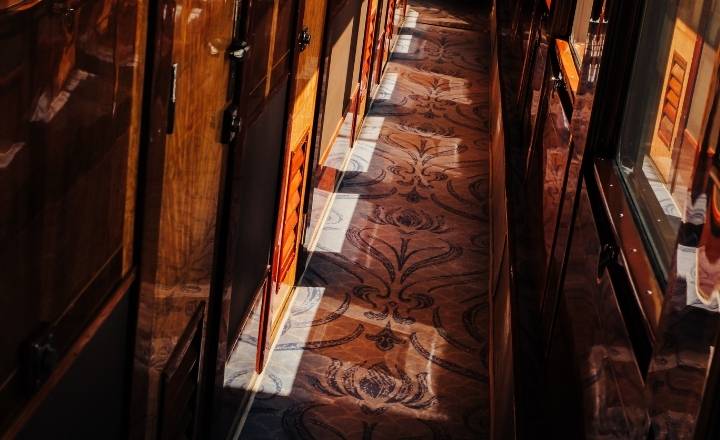
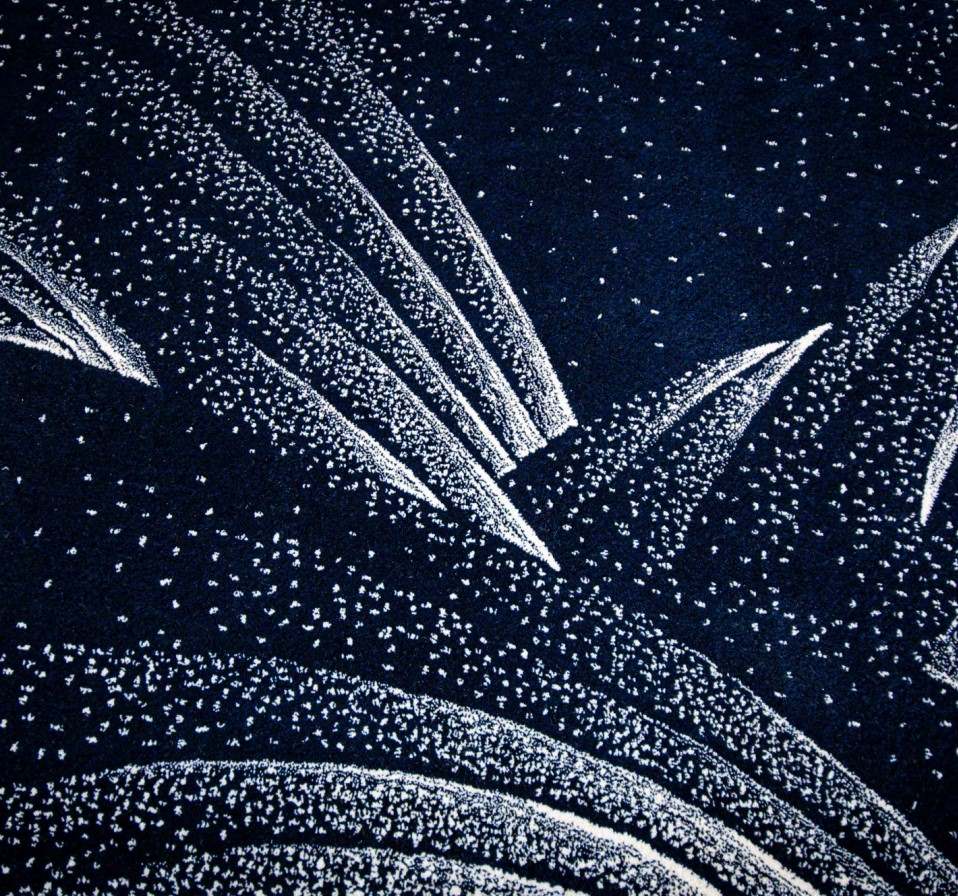
When in the suite, under your feet are hand-tufted wool and silk strands which appear to be a sky full of stars, a quiet and elegant reminder that with every stop, passengers stay unified under the same night sky, conveying an ethereal and eternal moment which lasts long after you take the journey.
Above the bed is a large, circular mirror built for the 198 cm wide rooms, a nod to the mirrors found on train platforms that conductors used to check the length of the train and to the original décor of the Wagons-Lits (sleeper trains). Following the motif of the circles, adorning the suite are also oval shelves which hold newspapers and travel souvenirs to commemorate the journey.
Lastly, behind marble-adorned sliding doors is the ensuite bathroom to complete the suite and personal hideaway.
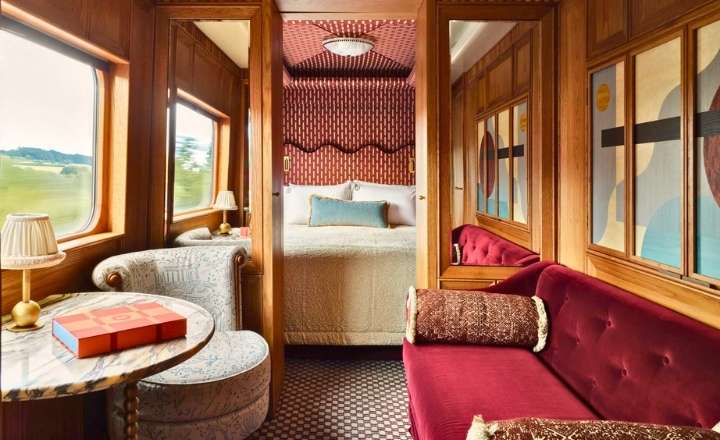
During the day, the suite is outfitted with a sofa and settee – an invitation to rest, relax, and peer outside the leather-trimmed windows to the passing light and landscapes.
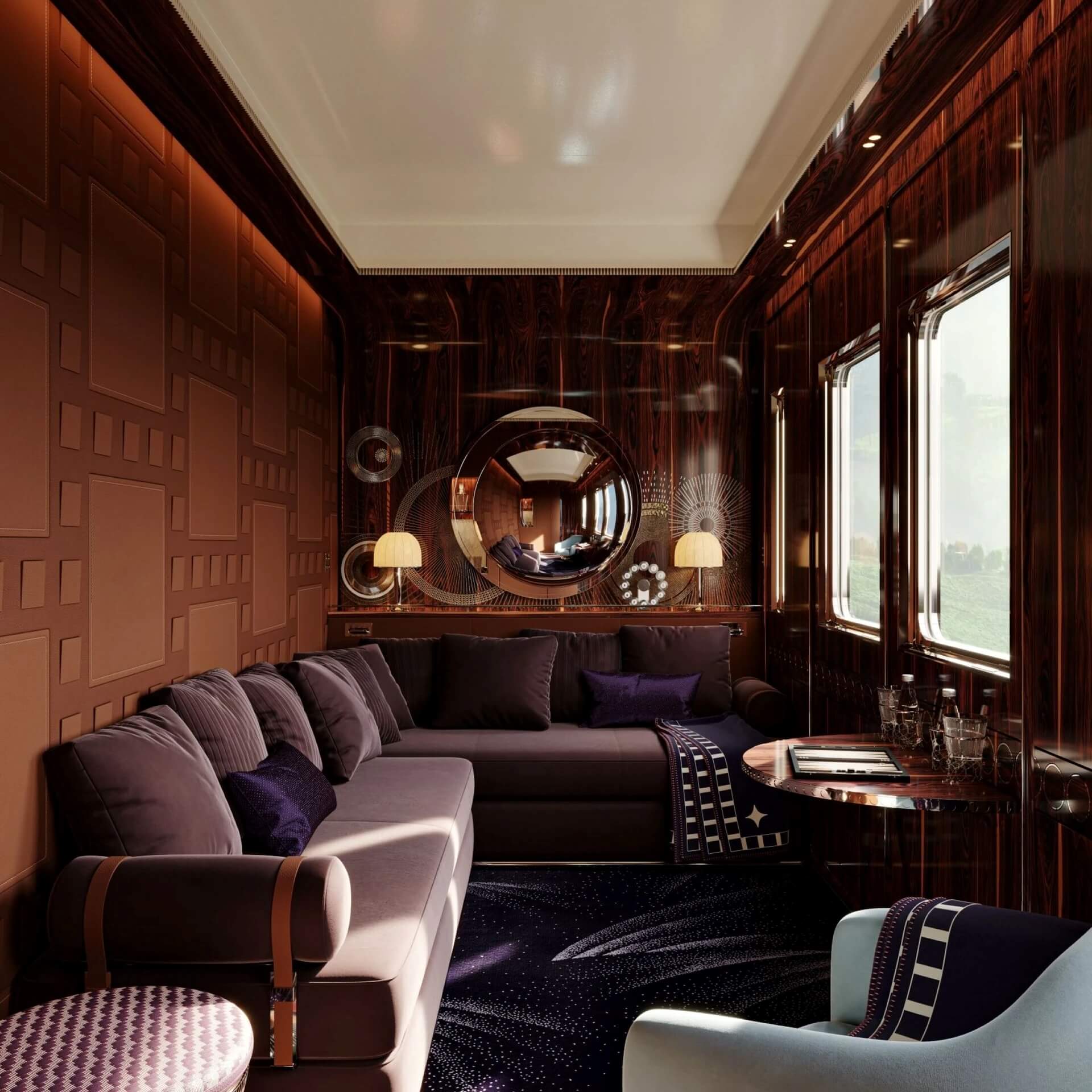
By evening, the suite undergoes what is aptly named 'The Great Transformation’. The sofa becomes a 2 x 1.40 metre bed, inviting you to a deep, restful night of sleep aboard the L’Orient Express after a day of indulgent travel.
L’Orient Express Bar Car
Frosted-glass light domes cover the roof of the L’Orient Express bar car, supported by four columns. Opulent and inspired from the Second Empire and Art Nouveau styles, the car revels in both hedonistic splendour and precise elegance.
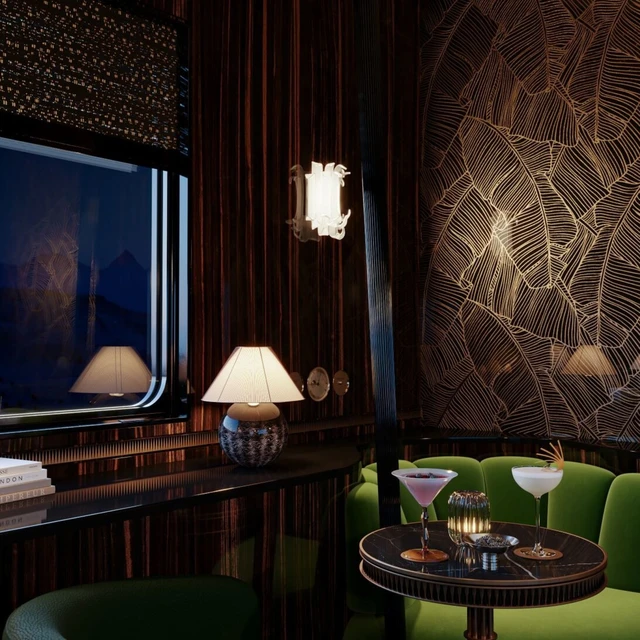
The bar car lounges use vivid green hues alongside the rosewood and marble, emanating a sense of liveliness and quiet luxury, recalling the glamour of 19th-Century salons with a modern take on lighting and composition. The vaulted ceilings feature “flower-lamps” signed by Lalique which were original pieces, recovered from the original Nostalgie-Istanbul Orient-Express.
Large windows feature embroidered curtains and support bars that encourage viewing and conversation. Glass panels, hand-chiseled and gilded banana-leaf shapes diffracts the light just so, casting a shimmering glowing light to the room.
Inviting velvet-green ribbed banquettes decorate the bar, emphasising the comfort and welcoming roundness of the alcoves. A fluted glass bar defines the space – playing again on light and reflection, inspired by the work of Lalique.

Inspired by leading figure of the Art Deco movement, Jean Dunand, the carpets feature a floral motif that is yet again reminiscent of banana fronds – a design reflecting the banana blossom adorning the marquetry in the panels of the 1924 Orient Express. The irregularities in the natural form of the banana fronds animates the space and brings the car to life.
L’Orient Express Dining Car
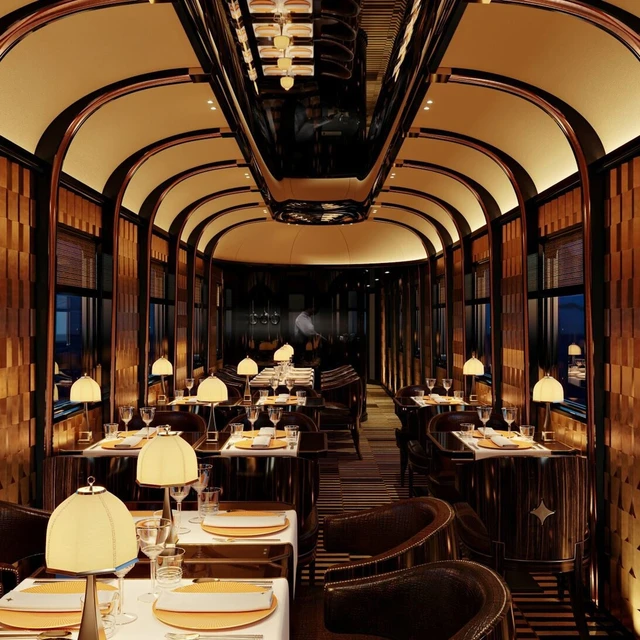
From the mirrored ceiling of the car, the marquetry, and the open kitchen – visible through a rippled-glass partition – the restaurant car is designed with intentional intimacy without ever feeling like anything but the opulent yet restrained display it embodies.
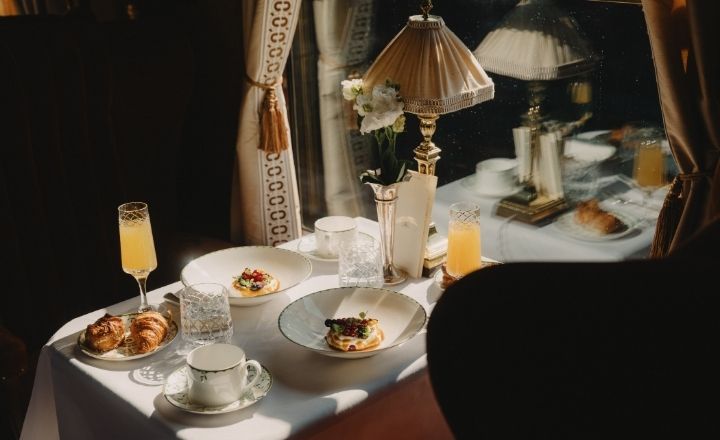
Down to the silverware and glassware, each part has been carefully crafted and curated to be a poetic extension of the Nostalgie-Istanbul Orient-Express’ essence and tributes to the Lalique Maison’s creative heritage. Beauty meets precision in the French art de vivre, a reminder to savour and enjoy luxury and life.

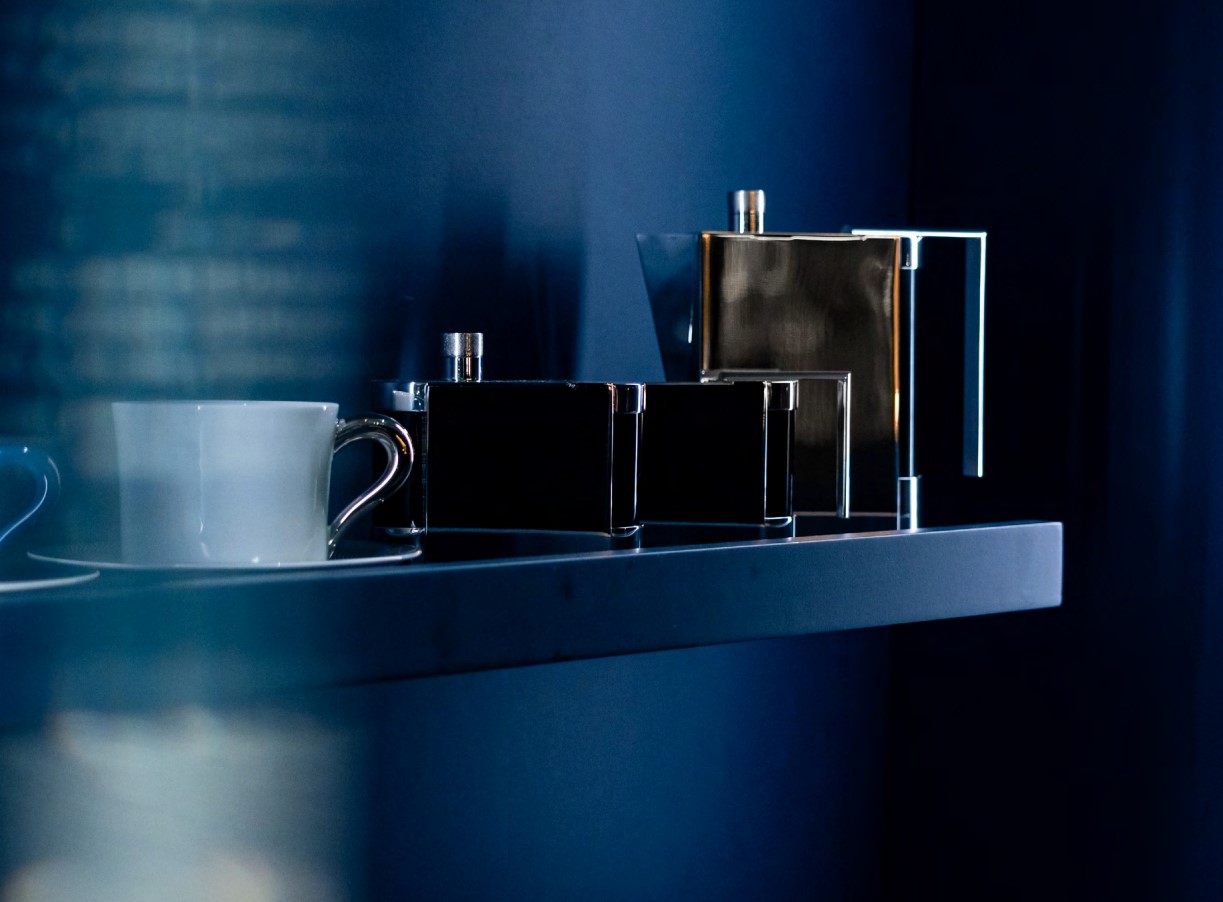
The glassware collection is crafted from hand-cut crystal techniques; the knives handles with wood salvaged from a historic Orient Express carriage, engraved with the original carriage number – a forever-link to the past and deep history of this journey; the teapot which is angular, easily-stored, “attuned to the train’s aesthetic language.”
The walls feature again, the Lalique-inspired rail motif - made with ‘stone-cardboard’ which is a technique that was lost in the early 20th-century – recovered and modernised by Atelier d’Offard.

Another traditional craft revived, although not lost to time, by the L’Orient Express is, dinanderie – forming copper, brass, tin sheet without any casting. It's done by hammering the material by hand into shape. A centuries-old rare technique used to build a beautiful arched structure in the dining car which curves and connects to the mirror mounted above.
Artists Behind the Decadence of L’Orient Express
D’Angeac, alongside various other master artisans, breathes new life into the carriages in their vision for the L’Orient Express, working to capture and extend the spirit of L’Orient Express.
With a focus on French craftsmanship, d’Angeac has composed a symphony of artisans and historic luxury Maisons to revitalise L’Orient Express, from the ‘blackbird and grape’ wood panelling to each ticking Cartier clock on board.
Ateliers Philippe Coudray & Atelier Chauvet
Founded in 1974 in Pantin, Ateliers Phillipe Coudray and their dedication to reviving the grand French decorative arts means they’ve been entrusted with the creation of the window blinds, window frames, and wall hangings. Seen on the suite’s walls is d’Angeac and the atelier’s bold reinterpretation of Suzanne Lalique’s ‘rail-motif’ by playing with the size of the original drawing, and working in volume, giving way to the enlarged print – geometric and rhythmic.
In the dining car, the atelier’s work on the blinds can be seen as well – woven metal thread and Lesage embroidery. This level of care and dedication to detail is seen in all the cars: the suite, the dining car, and the bar car.
The central element of the train’s design is the window – built by Atelier Chauvet. With their expertise in metalworking, the workshop integrated all the embellishments alongside it, inclusive of the Phillipe Coudray’s blinds. The windows are trimmed with leather and have a seamless finish. Similarly, the atelier also worked on the mirror polished bases for some of the seating on L’Orient Express by Ateliers Jouffre.
Atelier Studio Perspectives
Family enterprise, Atelier Studio Perspectives, is a business founded in 1974 in Vouillé. It is a company with expertise in engineering for high-end and luxury travel – outside of their work on L’Orient Express, they’ve worked on Dassault Falcon and Silenseas.

For Studio Perspectives, L’Orient Express is their second time working on an Orient Express project with Maxime d’Angeac. Studio Perspectives upholds the absolute ease and comfort of passengers on-board this luxury train experience. The atelier integrated all onboard systems and 30 trades, accounting for space, the constant motion, and vibrations of a moving journey – all while preserving the artistic integrity of each piece on board.
Atelier Barrois
Since 2010, Emmanuel Barrois has been leading the Atelier team of artisans, technicians and engineers, building expertise in glassmaking. For L’Orient Express, they designed elements of the bar and dining cars, as well as the centerpiece witch mirror for the suite.
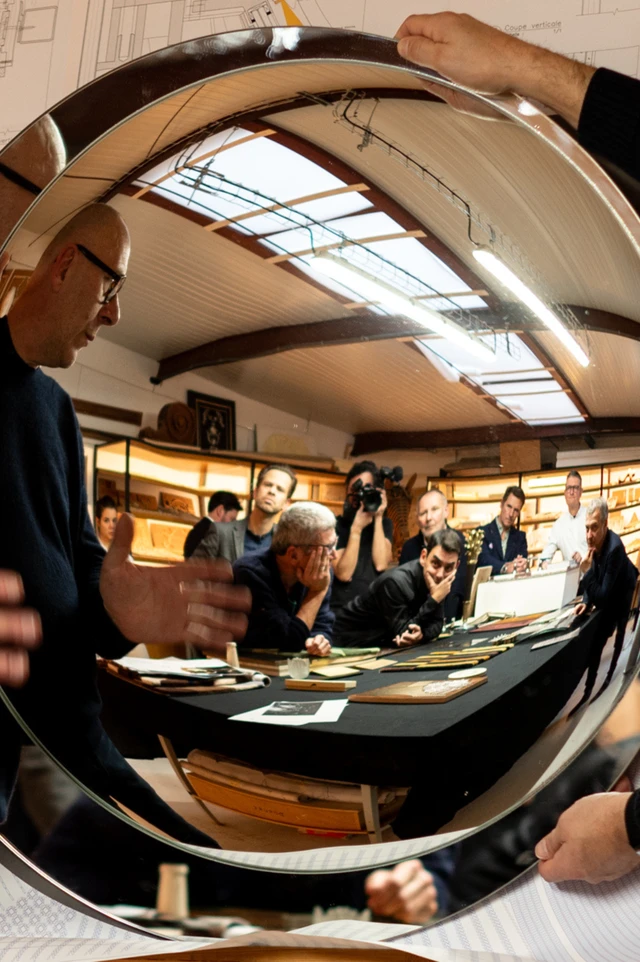
The convex mirror is reminiscent of the mirrors found on train station platforms, used by conductors to observe the length of the train as well as inspired from the mirrors used as décor aboard historic Wagons-Lits (sleeper trains).
Barrois also crafted the frosted glass-domes which vaults above the space in the bar car, reminiscent of the venue interior of Cirque d'Hiver Bouglione, at 110 rue Amelot, evoking that same grandiose and jubilance.
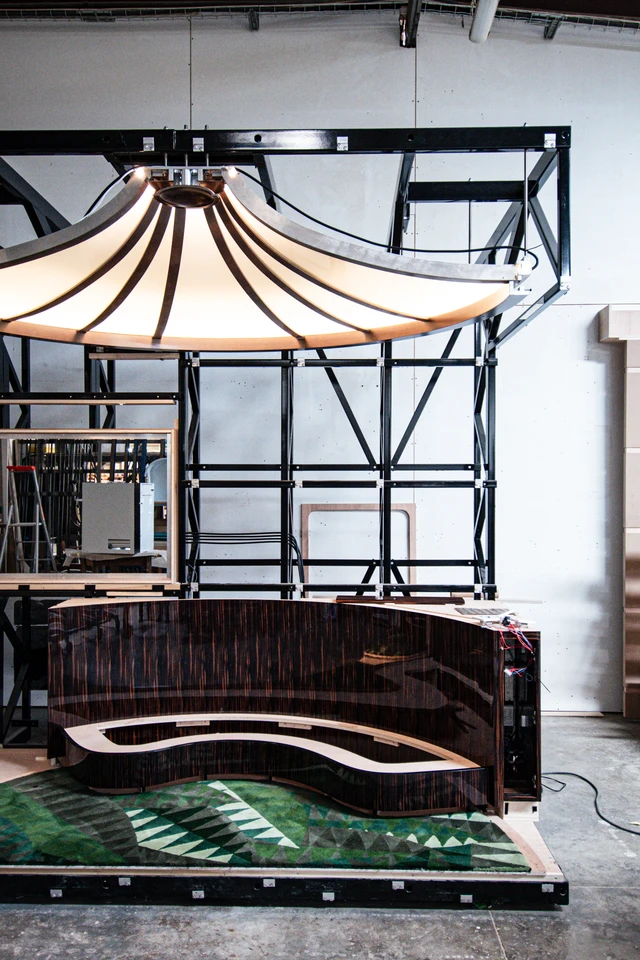
A celebration of Art Nouveau, the structure pays tribute to the way the artistic movement played with curves, geometry, and materials, all the while lifting the room up, elevating the space, and presenting an impression of a grand stage.
Atelier Bernard Pictet
With the prestigious French-state label ‘entreprise du Patrimoine Vivant’ which marks them as a ‘Living Heritage Company’, Bernard Pictet was founded in 1981 and first awarded the label in 2008. Known for their expertise in glassmaking, the atelier innovated on several techniques which create optical effects with glass and pioneered the invention of the kinetic glass.
Designed by Maxime d’Angeac for the bar car, Bernard Pictet produced the two golden banana leaf glass panels. This commission combines sandblasting and burinage techniques. Burniage in particular, is a technique that was highly fashionable in the 1930s, which involves chiseling away glass in a pre-cut groove which catches and diffracts the light.

The panel then sees the first pass of gilding with tinted-black silver leaf, a secondary pass with the chisel, and finally, the gold leaf, which shows the beautiful, shimmering pattern of the chiselled fronds.
Atelier Etienne Rayssac
As another atelier awarded the prestigious French-state label ‘entreprise du Patrimoine Vivant’ which marks them as a ‘Living Heritage Company’ in 2011, Etienne Rayssac has been conserving the art of ornamental sculpting. A contributor to many restoration and decorative projects such as the Palace of Versailles, Palace of Fontainebleau, Dôme des Invalides, and Musée Rodin as well as collaborating with luxury maisons and leading architects.
Seen on every corner of L’Orient Express is the work of Atelier Etieene Rayssac who makes their feature on all the decorative friezes on-board. Sculpting in wood, the friezes for the bar, tables, suites, panels, capitals of the columns, the pilasters, the veneers, the door handles as well as the petal-shaped wall-lights. Lastly, Etienne Rayssac also created an Art Deco bas-relief (low relief, sculptural technique where designs shallowly project from the background) inspired by Maison Lalique, of vine leaves and grape-clusters.

Atelier Rinck
Born in the historic cradle of cabinetmakers, Faubourg Saint Antoine, Rinck’s expertise lies in rare crafts of marquetry, woodcarving, gilding, and French-polished varnish. There’s a true commitment to detail and precision.
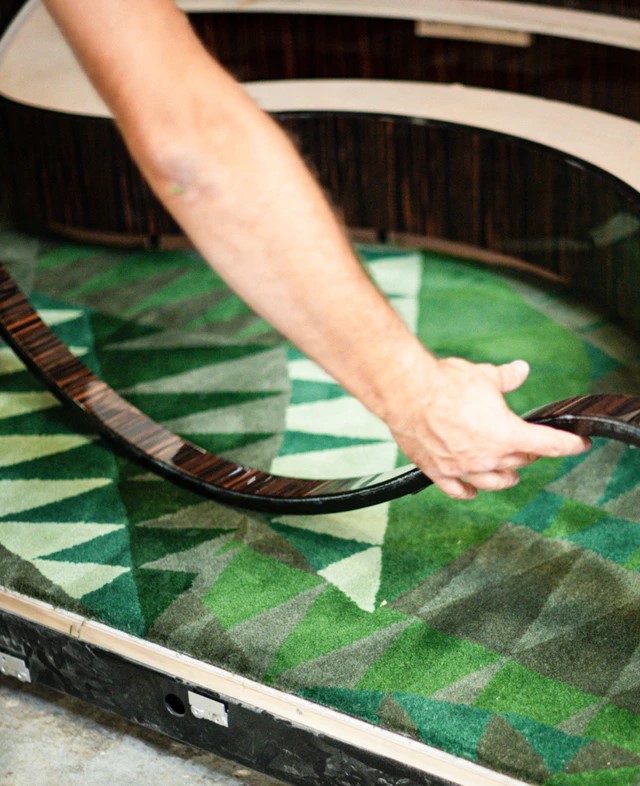
Building from Maxime d’Angeac’s vision for L’Orient Express, Rinick brings to life the rosewood panelling, wall coverings. Integrating the furniture and lighting precisely, with meticulous care. The concept is brought to life in the hands of Rinck.
Ateliers d’Offard
Ateliers d’Offard is a French workshop with artisans specialising in hand-block-printed wallpaper and carton-pierre.
For L’Orient Express, this artists’ collective has created the wallpapers on-board, in one such case taking inspiration from Suzanne Lalique-Haviland's rail motif, featuring 1,200 hand-shaped and gold-leaf gilded ‘stone-cardboard’ bricks which decorate the restaurant car – a technique lost during the dawn of the 20th century.
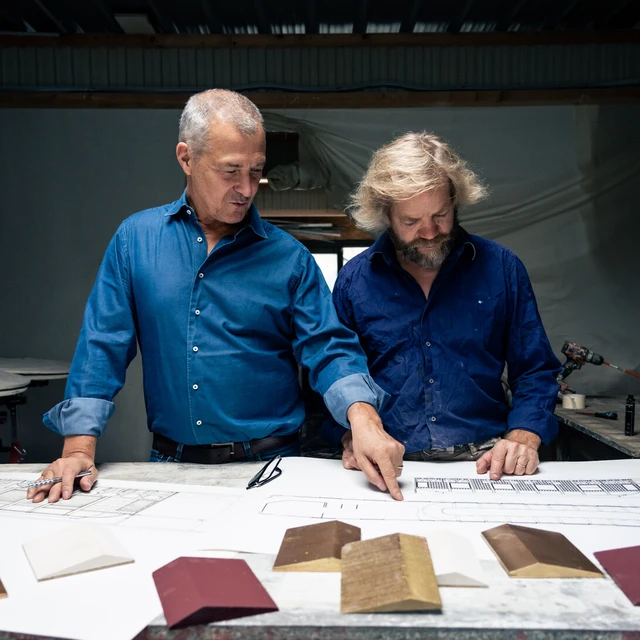
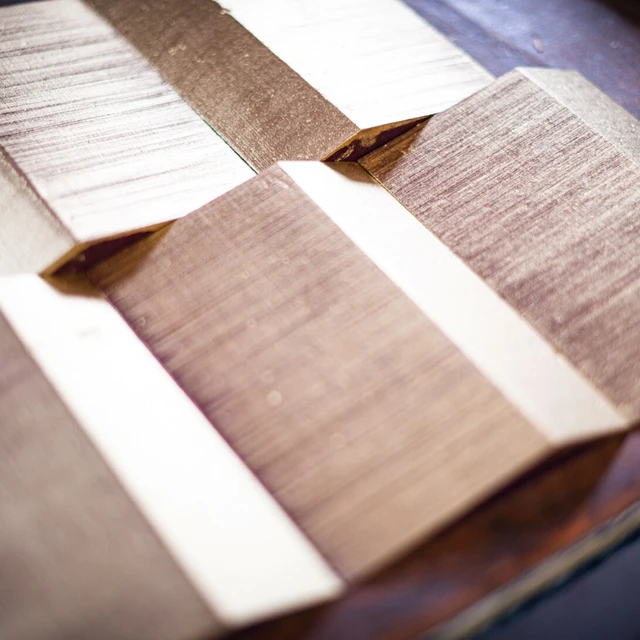
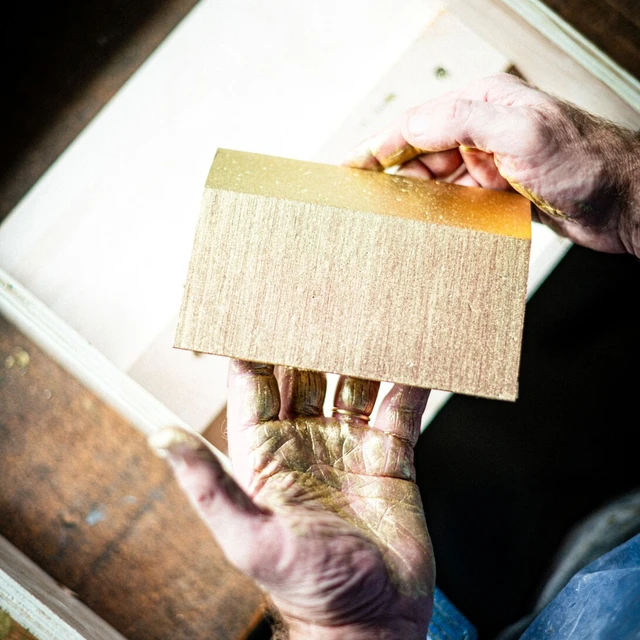
Revived and discovered by the Ateliers d’Offarf to bring back the volume, flexibility, weight, and ability to capture light, bathing the carriage in a warm, golden glow.
Atelier Moderne Pulsatil
Founded by engineers, Atelier Moderne Pulsatil endeavours to take a new approach to art and lighting. The collective specialises in custom-made luminaires with refined aesthetics. They created a new interpretation in their lamp design inspired from the historic models used on the historic train.
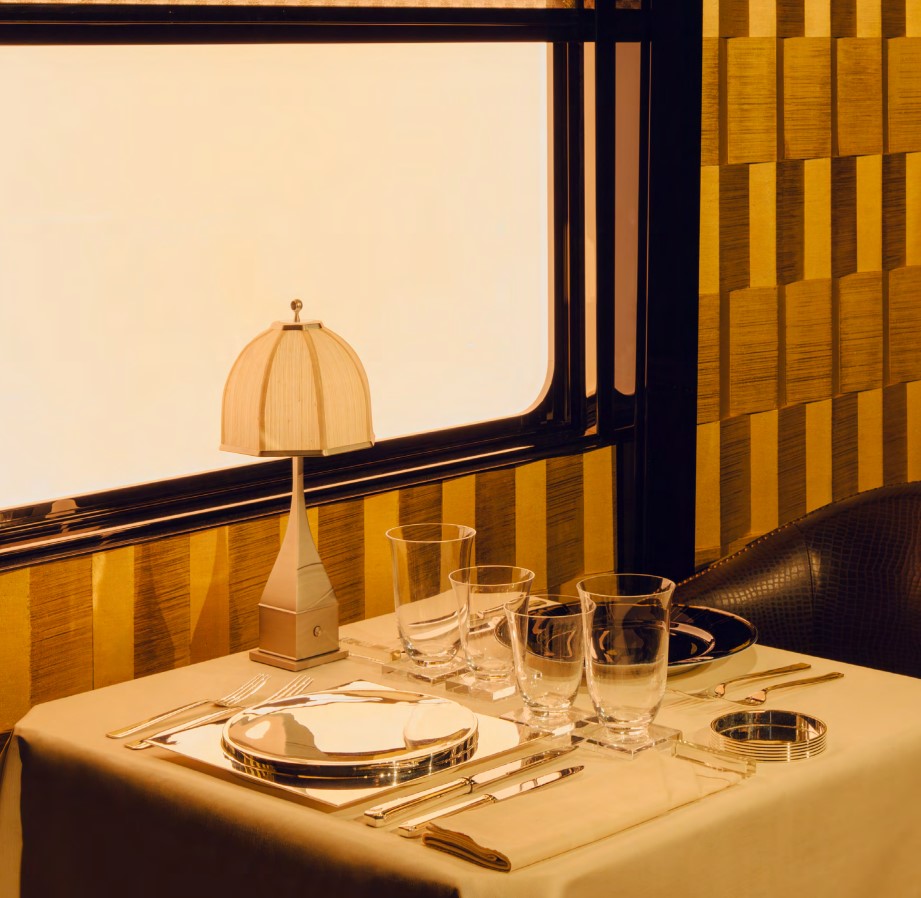
These lamps can be seen on-board each table of the dining car, providing a warm and soft glow to the carefully crafted cusine and each dining experience on-board L'Orient Express.
Jean Brieuc Atelier
This workshop, founded by Jean Brieuc in Angers, specialises in wood marquetry and embroidery, focusing on tradition and innovation.
Aboard the L’Orient Express, Jean Brieuc Atelier produced a centrepiece headboard on embroidered rosewood panels (designed by Atelier Paul Champs) with Japanese glass beads.
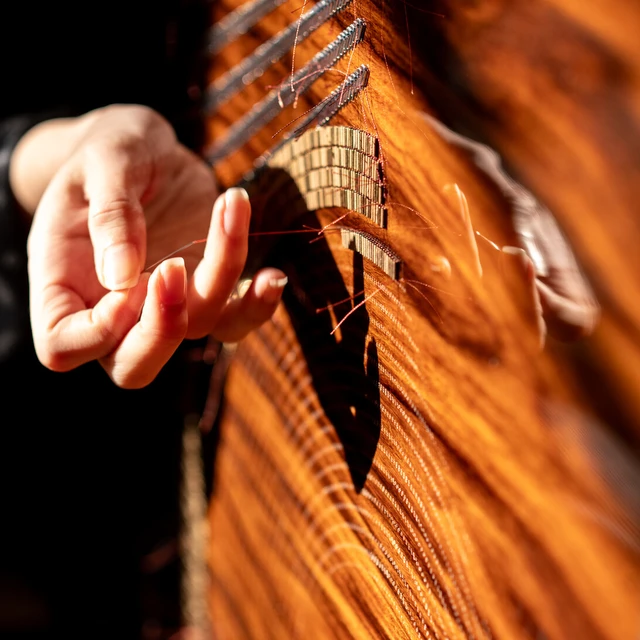
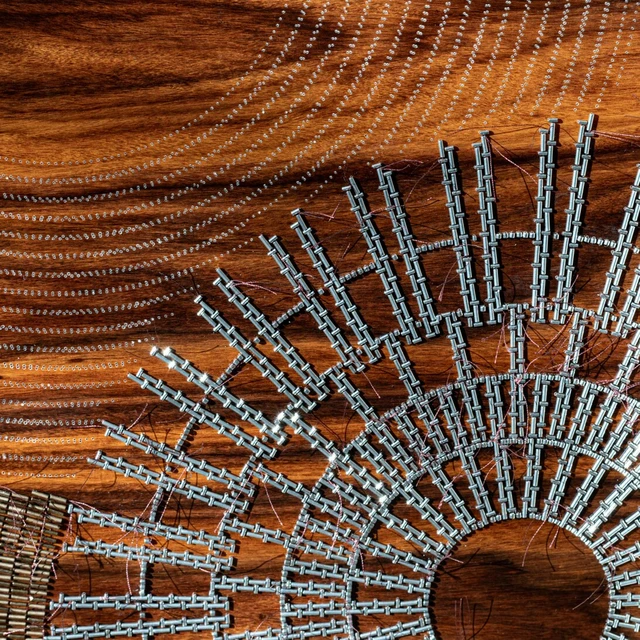
In the presidential suite, the design and technique is modified onto a velvet panel composed of cords, beads, and soutache braids embroidered to create a visually lavish, tactile, and textured headboard with an Art Deco-inspired design.
Atelier Jouffre
Specialising in upholstery, with workshops in Paris, London, Rabat and New York, Atelier Jouffre blends “the fine tradition of the upholsterer’s profession” and French luxury.
Atelier Jouffre created the modular system of L’Orient Express’ suites’ bed-settees – a lounge by day and a bedroom by evening as well as the armchair and ottoman seen in the suites. The banquette seating in the bar and restaurant cars were also the work of Atelier Jouffre, conveying and facilitating comfort and connection in communal spaces with their furniture pieces.
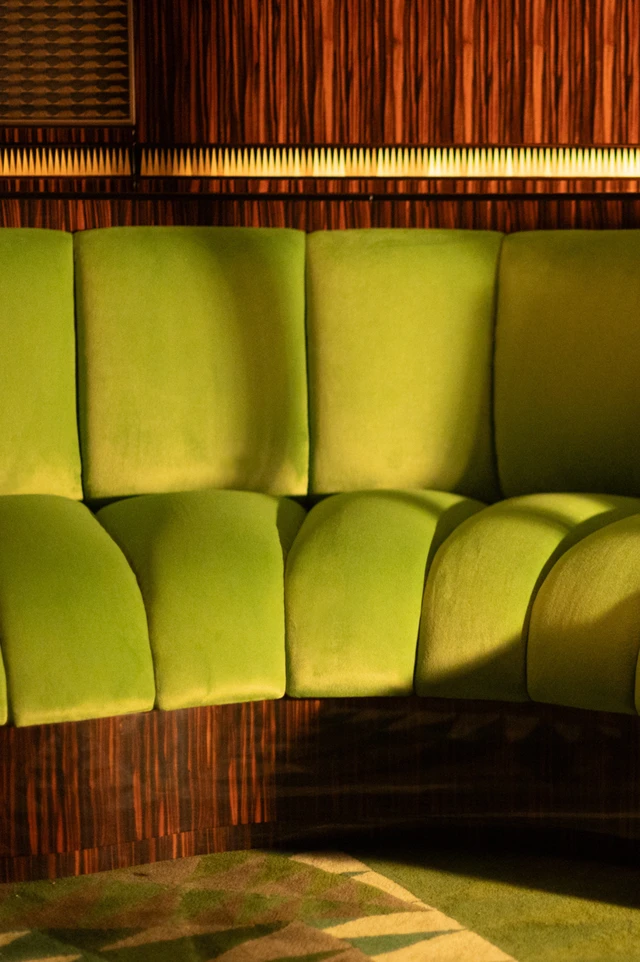
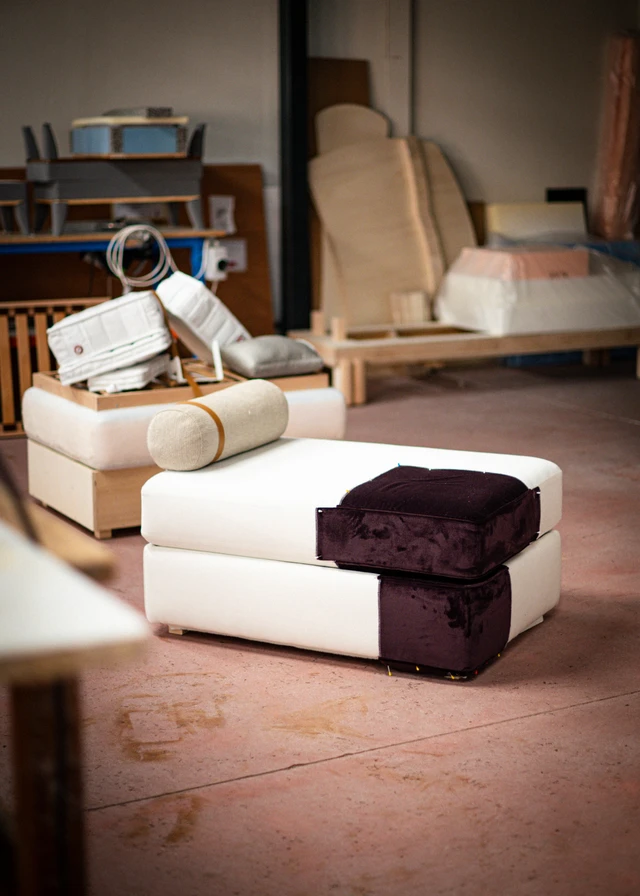
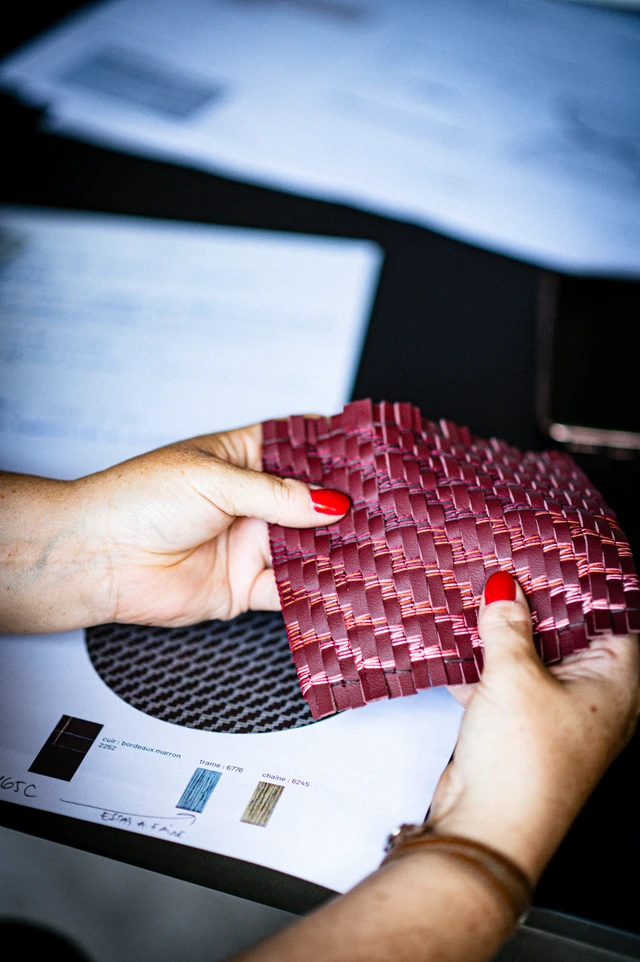
Atelier Jouffre perfects 'seating' down to the most minute details, ensuring absolute excellence and reverie in comfort – from their métronome armchair that rocks back-and-forth in responsive and rhythmic fashions to their diapason stool, which is inspired by the bilboquet, channelling the essence of balance with visually distinct woven leather (courtesy of Atelier Lily & Léa).
Atelier Nathanaël Le Berre
Based in Aubervilliers and founded in 2004. The work produced by the Atelier uses ancient techniques, creating unique forms in metal. Using the original tools of master metalworker, Gabriel René Lacroix, Nathanaël Le Berre’s atelier shapes sheets of metal with hand through a slow meticulous process.
Executed by Nathanaël Le Berre himself, the dinanderie arched structures seen in the dining car of L’Orient Express are the work of the atelier.
Dinaderie is a traditional technique which gets its name from Dinant, Belgium. Dating back to the Middle Ages, this craft was elevated during the 20th century by artists like Jean Dunand to the rank of fine art by blending the traditional skill with the boldness of modern art.
Atelier Février & Manufacture de Tapisseries de Bourgogne
Atelier Février is a workshop based in Paris, France specialising in hand-knotted rugs, fusing contemporary styles and traditional craftsmanship.
For the bar car, Atelier Février worked on the banana-leaf rug inspired by the designs of Jean Dunand, intricately designed to be reminiscent of the marquetry of banana leaf blossoms which adorned the 1924 Orient Express.
Spearheading the design for the rugs aboard L’Orient Express suites is Maxime d’Angeac and Atelier Février. Composing a monochromatic-palette that produces piece which takes over three-thousand shades, allowing for remarkable depth and precision.

Manufacture de Tapisseries de Bourgogne creates hand-made carpets – tufted and woven by specialists. For L’Orient Express, three hand-tufted models were produced, entirely from silk and wool, embedded through canvas following the original drawing.
Agencement Paul Champs
Brest-base workshop, Agencement Paul Champs is an Entreprise du Patrimoine Vivant, otherwise known as a ‘Living Heritage Company’ which is a label from the French government, acknowledging “French companies with rare, renowned or ancestral know-how”.
Agenceur Paul Champs produced over 15 different pieces for the suites. The bespoke rosewood panelling and wall coverings – integrating the curated furniture and bathroom.
Moser, Haviland, Christofle, Atelier Ganci, Atelier Perceval
For L’Orient Express, no detail is overlooked – the drinks and dining experience aboard has been elevated – from the best chefs to the best tableware set on the table.
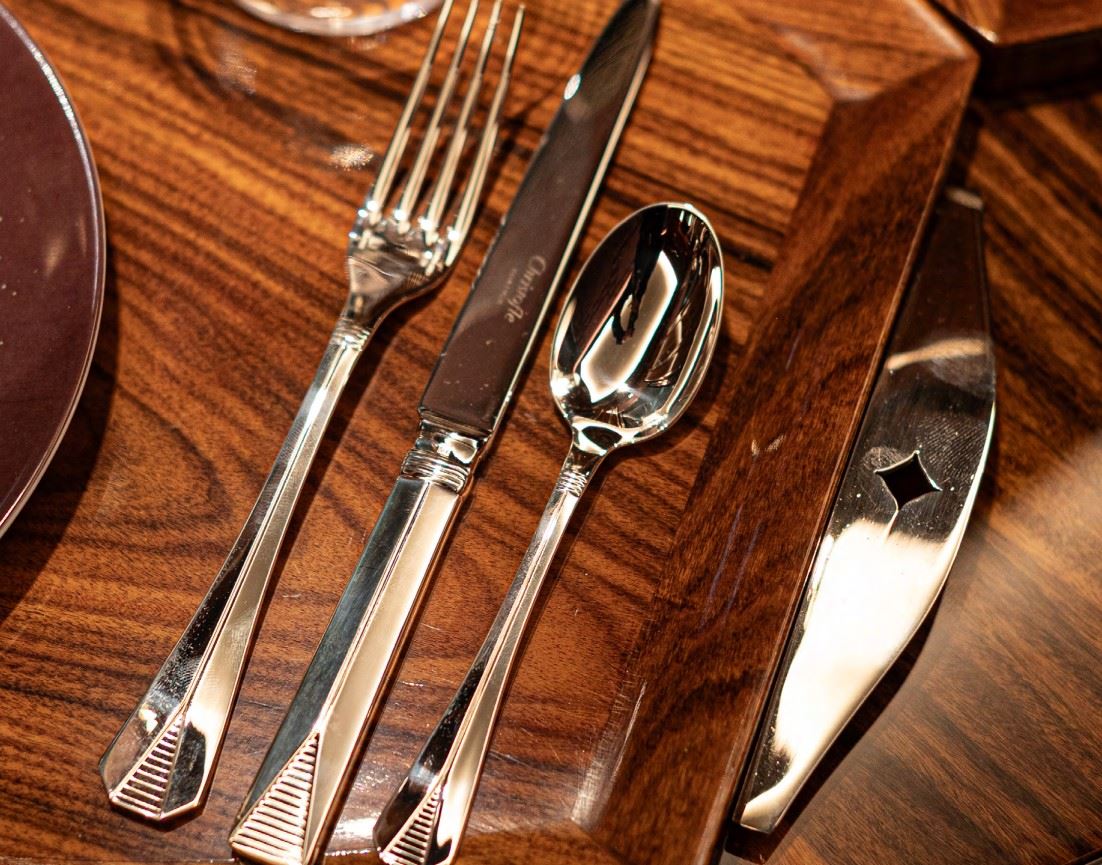
Christofle, a luxury silver and tableware Maison based in France, has reissued their Atlantide collection which were released during the peak Art Deco years. The delicate lines of the form meet the brilliance of the polished metal. This reissue is a rare gesture from the Maison, opening their exclusive archives to provide L’Orient Express a refined touch to the dining experience aboard.
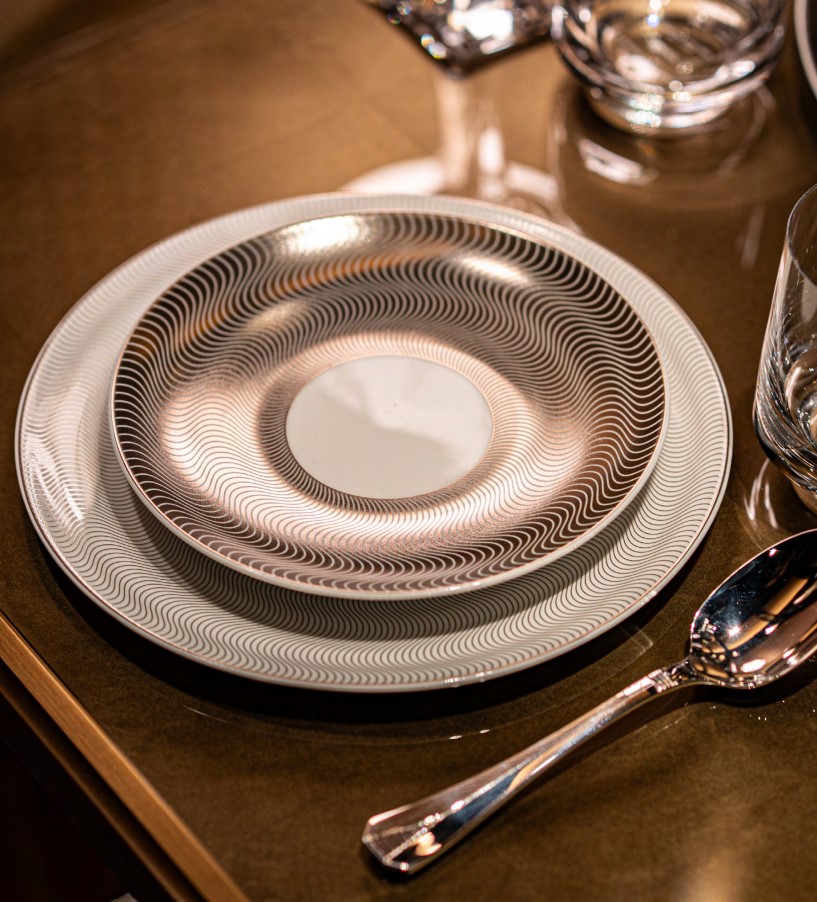
Maison, Haviland, from Limoges worked closely with d’Angeac to produce a collection of porcelain plates. The collection is a tribute to Suzanne Lalique-Haviland’s legacy as an artist and the Maison’s heritage, creating modern pieces which play with attributes of geometry and balance, playing with light, the spirit of Art Deco.
Beside the Atlantide collection and French Porcelain by Haviland, lies the knife created by Atelier Perceval. A French atelier specialising in high-end table, folding, and kitchen knives based in Thiers. The handle of the knife is crafted from salvaged wood from an original Orient Express carriage, the number of the carriage artfully engraved on the handles.
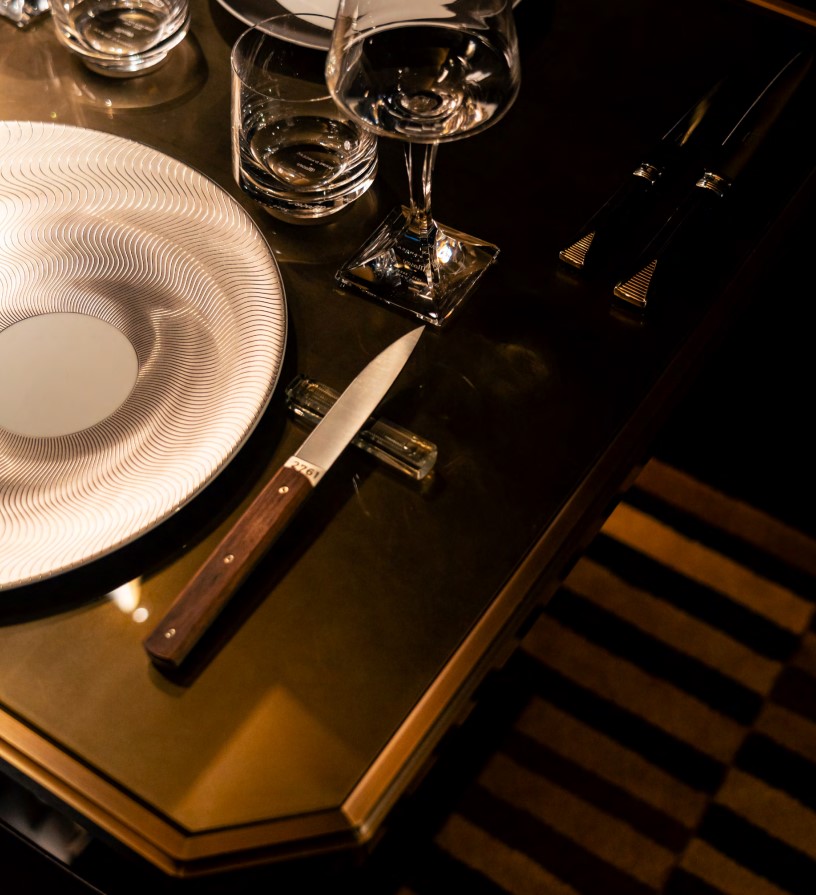
Every drink on-board is accompanied by glass from the Maison, Moser and their hand-cut crystal collection of glasses. Moser is one of Europe's longest standing glass manufacturers, founded in 1857 – specialising in lead-free Bohemian crystal. The collection was designed for various beverages on-board, drawing from the historic archives of Moser to produce a new modern collection for L’Orient Express.

Lastly, the teapot, produced by Atelier Ganci. Founded in 1926 in Milan, Ganci is known for their silversmithing, craft, and restoration of solid silver pieces. Their specialty in silverware has been welcomed to create a functional and faceted-teapot. Elegant, understated, “perfectly attuned to the train’s aesthetic language.”
Cartier
Luxury jeweller Cartier worked with d’Angeac to design three custom-made clocks to be used aboard L’Orient Express.
In each suite, a bespoke and unique clock features in each room. Numbers 1-35, omitting number 13, these clocks are always set to Paris time and are without an alarm.
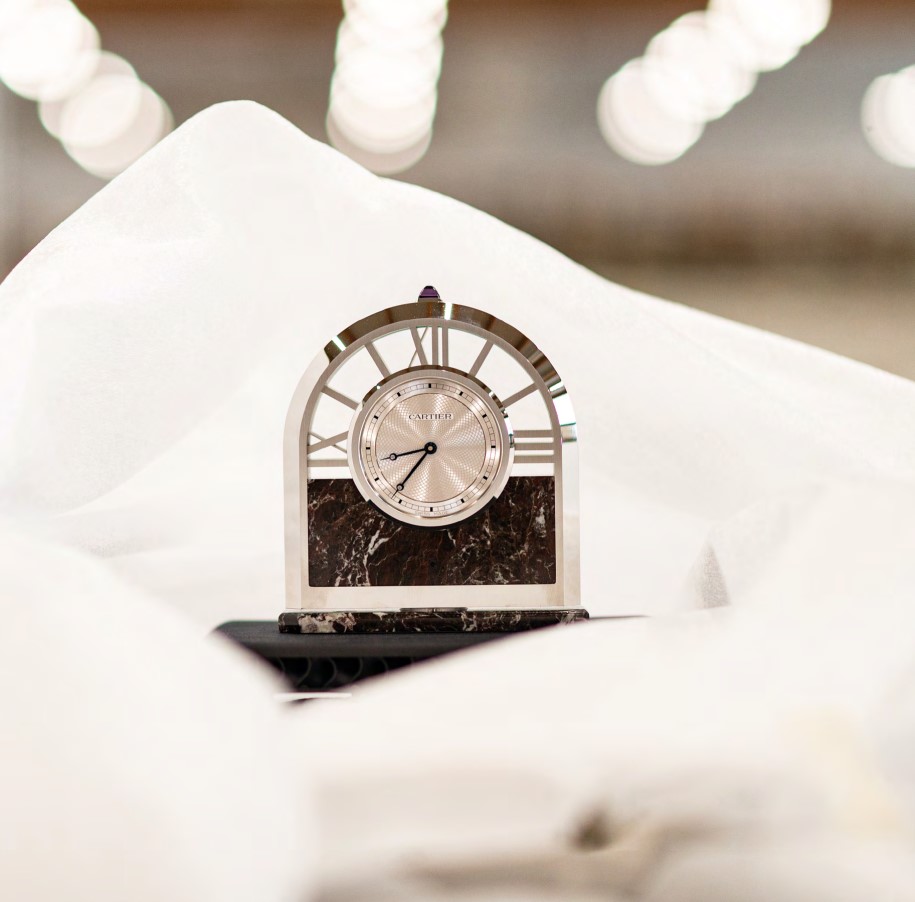
Within the bar car, there are an additional twelve Cartier clocks which marks time by events to match the rhythm of life on-board the L’Orient Express. Times are marked with Roman numerals and expressions such as “Coffee”, “Breakfast”, “Lunch”, "Aperitif", “Dinner”, and “Cocktail” which mirrors the rhythm of the rail-journey.

How much does it cost to go on L’Orient Express?
As it is not currently public-access information, the price for this experience has yet to be announced.
However, as a trusted agent for this journey, you can register your interest with us to be notified about the latest updates on the journey – be one of the first to hear about updates on L’Orient Express tickets and prices.
If you have any further questions about L’Orient Express journey, don’t hesitate to contact us, and our team of experts will be more than happy to answer any queries and provide you with additional information you may require.
How to book L'Orient Express
Because L’Orient Express is a brand-new addition to the rails, full departure schedules, routes, and pricing have not yet been officially released. However, you won't have to navigate the launch alone. Once dates and details are announced, the dedicated concierge team at LuxuryTrainTickets will be on hand to assist with inquiries, secure your preferred cabin, and help you plan your voyage. Keep an eye on this space for updates, or register your interest early with their team to ensure you're first in line when tickets go live.